- From
- New Zealand
- Hospital for treatment
- Jiahui International Hospital, Shanghai
- Disease
- Advanced gastroduodenal adenocarcinoma
- Treatment/medical stage
- Kailimei® (satricabtagene autoleucel, Satri-cel, CT041)
Why choose to come to China
Josh was diagnosed with advanced gastroduodenal adenocarcinoma in late 2025 and despite receiving chemotherapy and immunotherapy in New Zealand, the disease continued to progress. Further testing revealed that the tumor was Claudin18.2 positive and HER2 negative. The family and medical team therefore began to search for treatment options targeting this target and contacted Shanghai Jiahui International Cancer Center.
Newly approved gastric cancer treatment option
On June 22, 2026, Kailimei® (satricabtagene autoleucel, development code CT041; abbreviated Satri-cel) was approved in China. Its approved indication is CLDN18.2-positive, HER2-negative advanced gastric or gastroesophageal junction adenocarcinoma after failure of at least two prior lines of treatment. Jiahui’s August report stated that the product was available only in China at that time. Josh’s individual treatment plan was developed following the hospital’s assessment.
From cell collection to completion of treatment
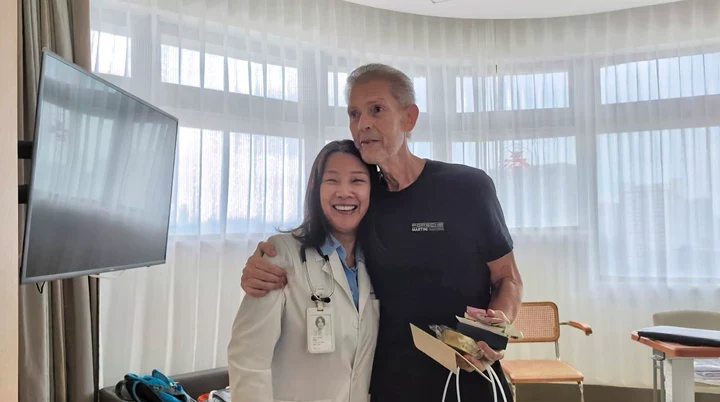
On July 6, Josh completed T cell collection in Jiahui. During the treatment, the team also dealt with issues such as malignant ascites and difficulty eating, and provided multidisciplinary support. The hospital reported that the amount of ascites drainage before treatment was about 1,000 ml per day, and the maximum amount was about 2,000 ml; the ascites subsided on the 10th day after CAR-T infusion, and the drainage tube was removed before discharge.
Medical connection after return to the country
Josh was discharged on August 16 and subsequently returned to New Zealand. Dr. Xuan Linli coordinated follow-up care with his treating physician in New Zealand. The published report documents symptom improvement and discharge at that stage; it does not report long-term survival or a definitive cure.
Report source
Jiahui Hospital · 2026-08-17 · View original report ↗
CARsgen Therapeutics: Approval Announcement on June 22, 2026 ↗
- 来自
- 新西兰
- 就诊医院
- 上海嘉会国际医院
- 疾病
- 晚期胃十二指肠腺癌
- 治疗/就医阶段
- 恺力美®(舒瑞基奥仑赛注射液,CT041)
为什么选择来中国
Josh 于 2025 年末被诊断为晚期胃十二指肠腺癌,在新西兰接受化疗和免疫治疗后,疾病仍然进展。进一步检测发现,肿瘤具有 Claudin18.2 阳性、HER2 阴性的特征。家人与医疗团队因而开始寻找针对这一靶点的治疗选择,并联系上海嘉会国际肿瘤中心。
新获批的胃癌治疗选择
2026 年 6 月 22 日,恺力美®获中国批准上市,研发代号为 CT041,英文简称 Satri-cel。其获批适应证是 CLDN18.2 阳性、HER2 阴性、至少二线治疗失败的晚期胃或食管胃结合部腺癌。嘉会在 8 月的报道中指出,该产品当时仅在中国可获得。Josh 的具体诊疗方案由院方评估制定。
从细胞采集到完成治疗
7 月 6 日,Josh 在嘉会完成 T 细胞采集。治疗期间,团队同时处理恶性腹水、进食困难等问题,并提供多学科支持。院方报道,治疗前腹水引流量每日约 1,000 毫升,最多约 2,000 毫升;CAR-T 回输后第 10 天腹水消退,出院前移除了引流管。
返国后的医疗衔接
Josh 于 8 月 16 日出院,随后返回新西兰。宣琳丽医生与其新西兰主治医生沟通后续照护安排。公开报道记录了这一阶段的症状改善和出院情况,未公布长期生存或最终治愈结果。