
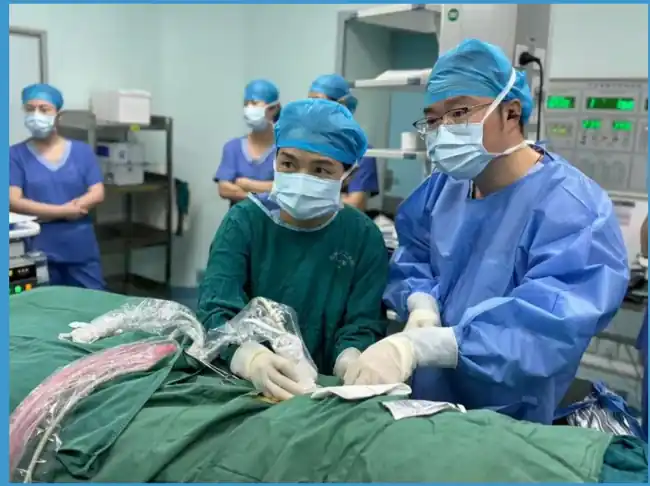
If you want to keep your uterus, the idea of treating fibroids with a needle raises two practical questions. Could this work for my fibroids? And what if I want to get pregnant later? The Department of Ultrasound Medicine at the Second Affiliated Hospital of Xi’an Jiaotong University has offered this treatment since 2018. The hospital reports treating FIGO types 0 to 6, including a fibroid 9 cm in diameter. Those figures describe the team’s experience. Suitability depends on the number and location of fibroids, imaging findings, symptoms and plans for pregnancy. Hospital report in Chinese
What stands out about the Xi’an team’s experience?
Radiofrequency ablation uses imaging to guide an electrode into the fibroid. Heat treats the targeted tissue, and the fibroid can gradually shrink. The aim is to ease symptoms such as heavy menstrual bleeding or pelvic pressure. A myomectomy removes the fibroid and provides tissue for pathology. NHS patient guide
The hospital describes how its team assesses fibroids close to the bowel or the outer surface of the uterus. Two fibroids of the same size may call for different approaches if one projects into the uterine cavity and the other lies next to the bowel. The team reviews the images and available working space and may consider protective measures such as fluid separation. If you are seeking a second opinion, ask about cases with a fibroid in a location similar to yours. Hospital report in Chinese
How is it used outside China?
| Country | Clinical use or research |
|---|---|
| United States | Sonata is introduced through the cervix and uses ultrasound from inside the uterus. Acessa is performed through small abdominal incisions with laparoscopic and ultrasound guidance. Both systems have FDA 510(k) clearance records. Sonata · Acessa |
| United Kingdom | University College London Hospitals provides NHS patient information about Sonata. NICE reports no major safety concerns in the evidence it reviewed for the transcervical procedure, but considers the evidence on effectiveness limited in quality. It recommends specific arrangements for clinical governance, consent, and audit or research. NHS · NICE |
| Spain | Eleven public and private hospitals took part in a prospective study of transvaginal ultrasound-guided radiofrequency ablation, assessing outcomes, safety and reproducibility across centres. Spanish multicentre study |
The Xi’an report does not specify which device or route was used for each case, so ask the team what it would consider for you. In the SONATA trial, roughly 8% to 9% of participants treated through the cervix had further surgery for heavy menstrual bleeding within three years. SONATA three-year results
The Zoying perspective: Three questions to settle before you travel
If your local doctor has recommended hysterectomy and you want to explore uterus-preserving options, or if you want a second opinion on a fibroid in a difficult location, the Xi’an team is one option to consult. Bring up any plans for pregnancy during the first consultation. Published evidence on pregnancy and delivery after ablation is still limited. Review of pregnancy evidence
- Which treatment would the team consider for me? Share your ultrasound or MRI reports and original images. Ask which fibroids the team would treat, which route it would use, and how ablation compares with myomectomy or other options.
- How long would I need to stay in Xi’an, and what would it cost? Ask for a schedule and a written estimate covering consultations, tests, anaesthesia, treatment and follow-up.
- Who will follow up after I return home? Ask when you need a check-up, how improvement will be assessed and who to contact if symptoms worsen.
Zoying can help organise your records, contact the relevant department and ask whether the hospital can review your case before you travel. You can then discuss a concrete plan with your local doctor before booking.