
Zoying Health Content Team | Updated October 25, 2026
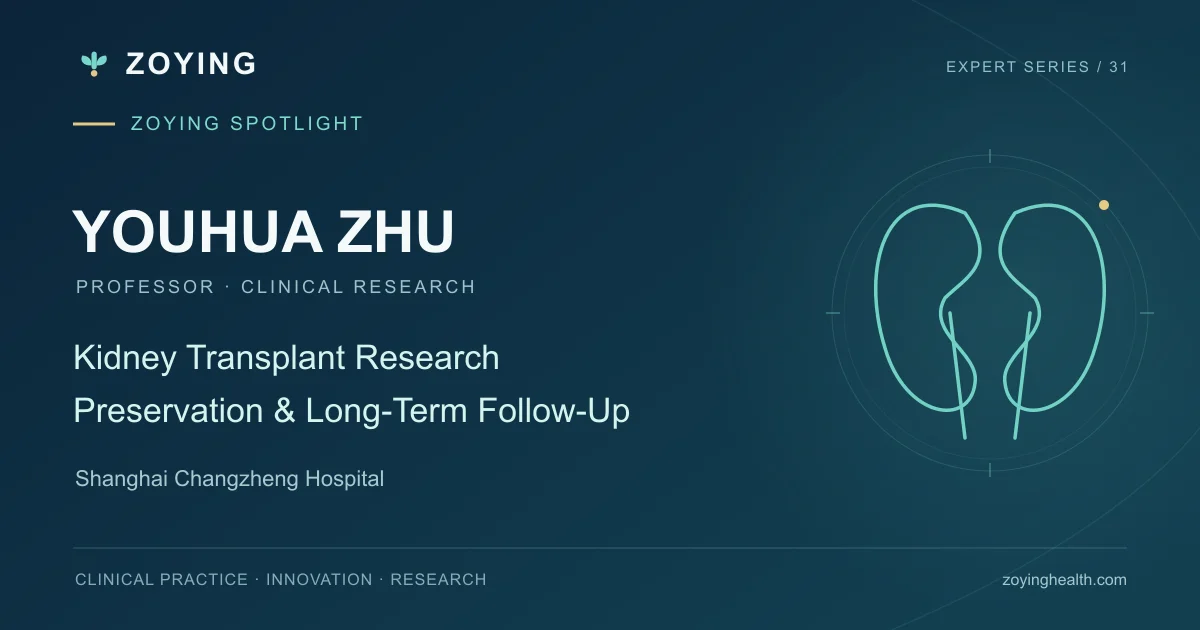
We are highlighting Professor Youhua Zhu because introductions to transplant medicine can focus on surgery and technical achievements while overlooking the years of care that follow.
Published clinical work involving Zhu includes kidney preservation. This helps document part of Chinese professional practice, but does not establish current eligibility for an overseas patient or promise an organ, waiting time or result. Original clinical publication
This article concerns professional background and continuing care; it does not offer kidney transplant arrangements in China. Technical success still needs medication, monitoring and medical continuity.
Why completion of surgery is not the whole measure
NIDDK describes transplantation as a treatment for kidney failure, not a cure, requiring anti-rejection medicines and follow-up. NIDDK patient information
Infection, adverse effects, cardiovascular and other health concerns may follow. KDIGO likewise includes graft monitoring and complications in recipient care. KDIGO recipient guideline
Patients therefore need to know who provides continuing care as well as where an operation takes place.
Why we pay attention to organ-preservation work
A 2014 multicenter publication involving Zhu compared kidney preservation solutions. It documents evaluation of one practical clinical component rather than a concept alone.
One preservation study does not represent every transplant outcome or prove that a particular solution extends an individual's life. Patients do not need to learn every experiment to understand the importance of ongoing care.
The point is that transplant medicine consists of several connected stages, not a technical detail packaged as an immediately available international treatment advantage.
Overseas eligibility is separate from a doctor's background
A center's experience and a clinician's work do not establish a foreign patient's eligibility. Qualified institutions and relevant authorities must confirm current requirements for eligibility, sourcing, donation, allocation and acceptance.
A tourist visit or routine inquiry cannot replace that process. Zoying does not offer organ trading, donor matching, allocation priority or waiting-time arrangements. This scope is separate from the professional information here.
For existing recipients, continuity of records matters
When moving or seeking another opinion, retain transplant history, immunological records, kidney results over time, relevant pathology, medicines and drug-level monitoring, and infection or rejection management.
A creatinine change alone is not a basis to diagnose rejection or change medication independently. The original or continuing specialist team needs the complete context.
Professionals must guide immunosuppression changes. Travel or an inquiry must not interrupt essential treatment.
Establish a continuing team before moving between regions
Before relocation, travel or another treatment, confirm access to a transplant or renal team, medicines and tests.
Discuss the original center's continuing role, transfer of records and where acute problems will be treated. Language support can improve communication but cannot replace local clinical capability.
Acute abnormalities need prompt care in the current system rather than waiting for a remote response.
Reading longer-term outcome reports
Institutional results provide context only when the period, patient group and follow-up are understood. Historical results are not a personal prognosis, and one favorable number should not be selected in isolation.
Translate the information into practical questions: what risks need observing, how can medicine and testing remain continuous, and what happens if results change?
Why ongoing care is the focus
Professional experience, current eligibility and continuing care need separate understanding. Knowing a clinician's background cannot settle an individual's access or follow-up conditions.
Zhu's work offers insight into part of Chinese transplant practice. Wherever treatment takes place, patients should expect a complete and sustainable care pathway.
Professional background and long-term care information only. No kidney transplant arrangements in China are offered. Qualified institutions determine current eligibility and clinical services.