
Fudan University Shanghai Cancer Center · Urology · Chief physician
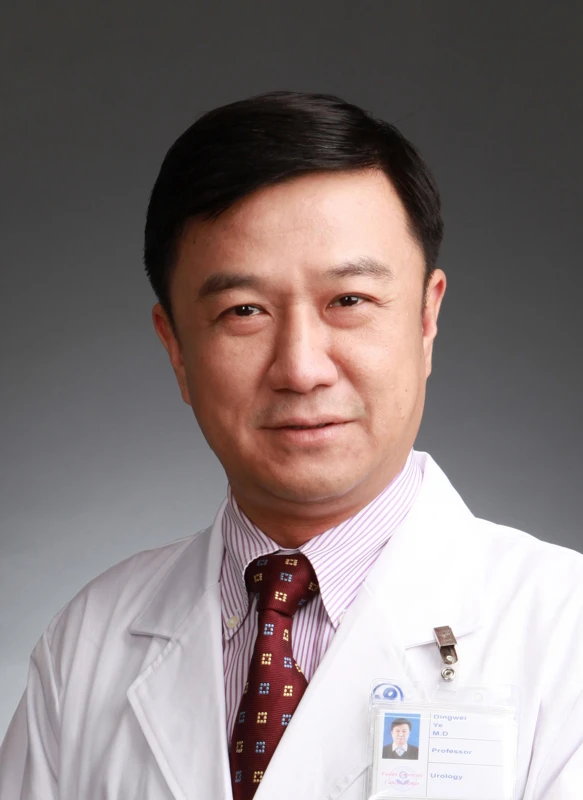
Dingwei Ye’s team has studied anatomical preservation and pelvic floor reconstruction in robotic prostate cancer surgery. He also coauthored CHART, a phase III randomized drug trial, extending his research beyond the operating room.
Why a prostate cancer study can matter to the family
In 2019 Fudan reported that Ye's team characterised inherited variants in DNA repair genes in Chinese patients with prostate cancer. An inherited finding may have implications for blood relatives, which makes the sample used for testing important. Fudan also documented the team's genetic counselling service for patients and families. A useful first question for someone with a genomic report is whether it tested tumour tissue or germline DNA, and which findings warrant counselling. [6]
More than a robotic surgery label
Fudan’s public profile describes clinical and research work in prostate, kidney, bladder and other genitourinary cancers, including signaling, the tumor microenvironment and translation. Hospital reporting also documents a practice connecting surgery, medicine research and multidisciplinary collaboration. [1]
For patients, the implication is that surgery belongs within a discussion of stage and overall goals. Localized, high-risk locally advanced and metastatic disease should not be described through one surgical narrative. Assessment should address why an operation is considered, its timing and alternatives, not only technical feasibility.
Clinical judgment remains central to robotic surgery
Hospital reporting describes the team’s robotic prostate cancer surgery and work on an innovation platform. A robot provides tools for instrument control and reconstruction; it does not independently determine the extent of resection or replace the surgeon’s assessment of cancer boundaries and anatomy. [2]
A 2025 hospital report describes technical work on anatomical identification, functional preservation and pelvic-floor reconstruction, as well as participation in clinical research on a domestically developed modular robot. The objective matters more than a device name: where oncologically appropriate, consider structures and recovery relevant to continence and sexual function. [3]
Recovery depends on baseline function, age, cancer location and extent, surgery and rehabilitation. Aggregate figures in institutional reports should not become a promise of preservation for every patient. A useful consultation makes the individual tradeoffs between cancer control and function explicit.
Research beyond the operation
Ye is an author and investigator in CHART. Published in Lancet Oncology in 2022, this randomized phase 3 trial compared rezvilutamide with bicalutamide, each combined with androgen-deprivation therapy, in high-volume metastatic hormone-sensitive prostate cancer. It evaluates medical regimens, not the efficacy of robotic surgery. [4]
A later publication examined patient-reported outcomes, including pain and quality of life. This is a reminder that expertise includes understanding the experience of treatment as well as imaging and operative results. Different disease stages need different evidence, and its applicability requires clinical interpretation. [5]
Why Zoying is introducing Professor Ye
We are interested in the connection between the team’s surgical work and clinical trials. It helps international readers ask specific questions about cancer risk, function and how surgery connects with later treatment. The receiving hospital still needs to confirm acceptance, the assessing specialist and whether multidisciplinary review is appropriate.
Patient questions
Does every prostate cancer patient need robotic surgery?
No. Stage, risk, health and goals determine whether surgery and other options should be considered.
Can continence and sexual function be guaranteed?
No. Preservation is an important goal, but recovery depends on individual health, cancer extent and treatment factors.
Which records should be prepared?
PSA history, biopsy pathology, prostate MRI, staging, previous treatments and urinary function may help. Begin with a brief inquiry, then confirm necessary records and private sharing.
Before you travel
To enquire about Dingwei Ye and Prostate cancer surgery and systemic therapy trials, include the specialist’s name and the question you would like answered. Zoying can ask the hospital whether records can be reviewed before travel and confirm the clinician, location, required documents and fees.
Enquire about a review with Dingwei Ye
Hospital records and research sources
- Fudan University Institutes of Biomedical Sciences: Dingwei Ye profile
- Fudan University Shanghai Cancer Center: urologic robotic surgery innovation center, 2023
- Fudan University Shanghai Cancer Center: Ye team’s medicine and device research, January 2025
- Gu et al. CHART phase 3 study. Lancet Oncology, 2022. DOI:10.1016/S1470-2045(22)00507-1
- CHART patient-reported outcomes, 2024. PubMed 39690158
- Why a prostate cancer study can matter to the family